Multi-object placement
Real robot Task 3 / dual arm / multiple objects
pi0.5Failure
Hermite-VLA RegSuccess
Representative Task 3 executions on the dual-arm platform. In the baseline rollout, a grasp correction flings an object and prevents task completion; Hermite-VLA Reg maintains stable contact and completes the sequence.
Real robot Task 3 / dual arm / multiple objects
Existing Vision-Language-Action models typically flatten each action chunk into per-timestep controls, leaving smoothness and boundary continuity to be learned implicitly. We instead parameterize the chunk trajectory as a piecewise cubic Hermite curve defined by endpoint positions and velocities.
We instantiate this fixed operator as Hermite Tokens, a Hermite Scaffold, and Hermite Regularization. The training-only regularization variant performs best, improving pi0.5 from 95.9% to 98.7% on LIBERO, 85.7% to 90.9% on LIBERO-plus, and 63.4% to 90.0% across four real-robot tasks without additional inference cost.
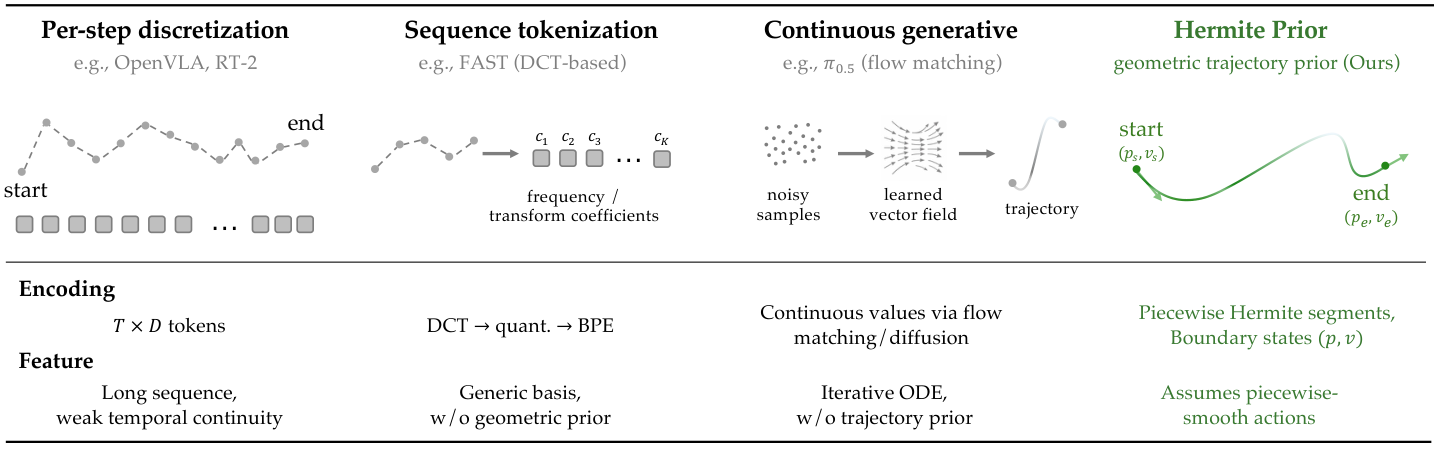
A single fixed Hermite operator supports three integrations into discrete and continuous VLA action modeling.
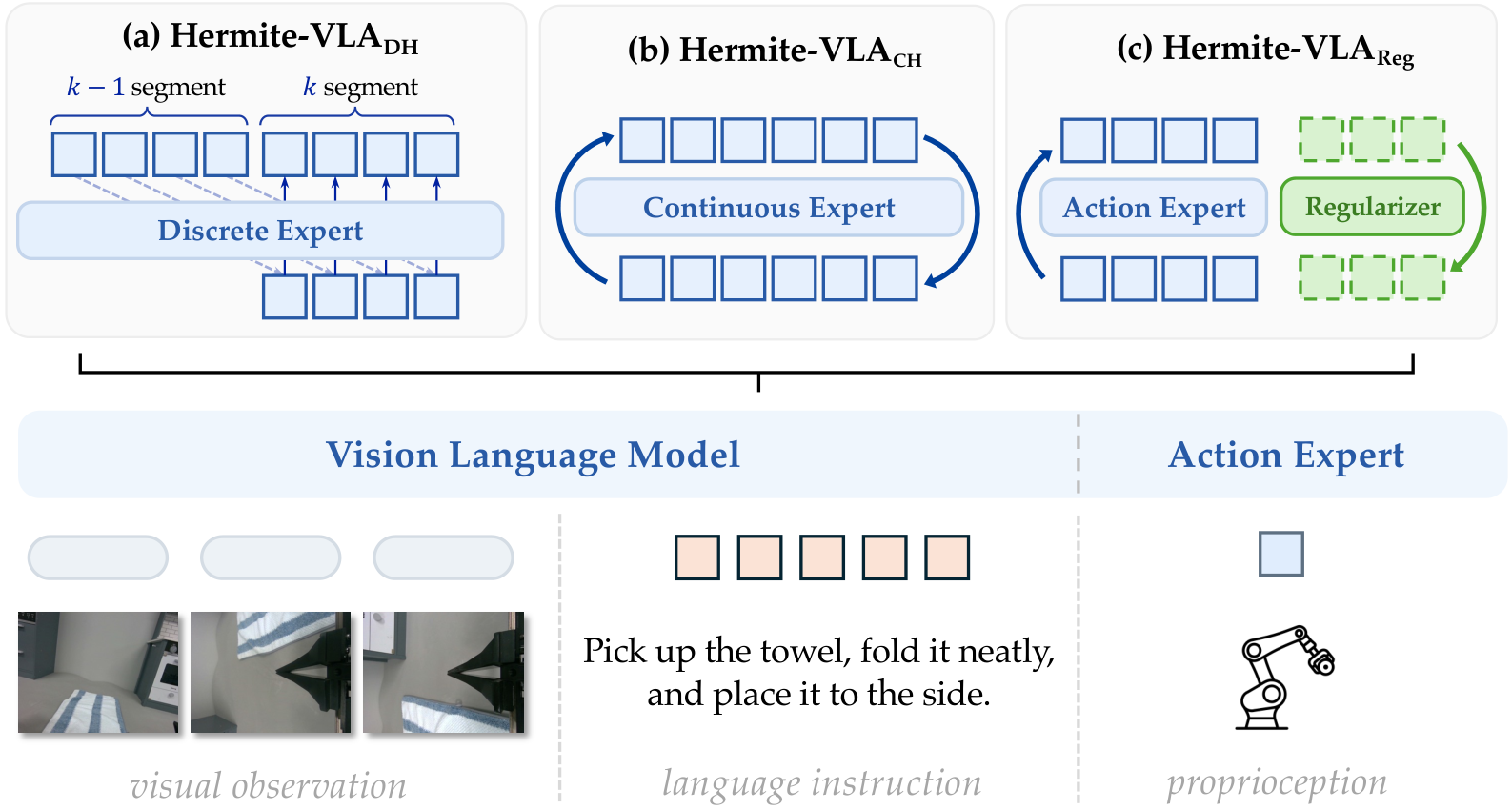
What is H? H is a fixed, non-learned interpolation matrix that maps boundary positions and velocities to a dense trajectory. It is not another backbone layer.
Discrete autoregressive
Predicts quantized endpoint positions and velocities instead of one token per action timestep.
Continuous generative
Decomposes each clean-action estimate into a Hermite scaffold and a per-timestep residual.
Training-only regularization
Uses a separate Hermite branch to regularize the shared action features during training.
Key finding: the least invasive design performs best. Hermite-VLA Reg shapes learning through an auxiliary trajectory objective while leaving deployment unchanged.
A piecewise cubic curve is determined by endpoint positions and tangents. The resulting speed profile changes immediately as its boundary state changes.
Hermite Regularization is strongest across in-distribution simulation, distribution shift, and physical execution while adding no inference-time module.
| Evaluation | pi0.5 | Hermite-VLA CH | Hermite-VLA Reg | Reg gain |
|---|---|---|---|---|
| LIBERO | 95.9% | 97.7% | 98.7% | +2.8 pp |
| LIBERO-plus | 85.7% | 85.1% | 90.9% | +5.2 pp |
| Real robot | 63.4% | 81.7% | 90.0% | +26.6 pp |
Success rates on 2,000 LIBERO rollouts, 10,030 LIBERO-plus perturbations, and 60 real-robot trials. Best result in each row is highlighted.
| Task | Platform | Instruction | pi0.5 | Hermite-VLA Reg |
|---|---|---|---|---|
| 01 | Franka / single arm | Open the pot, place the wooden block, and close the pot. | 86.7% | 100.0% |
| 02 | Cybopal / single arm | Open the pot, place the wooden block, and close the pot. | 26.7% | 66.7% |
| 03 | Cybopal / dual arm | Open the lid, place all blocks and balls, then close the pot. | 46.7% | 93.3% |
| 04 | ARX / dual arm | Pick up the towel, fold it neatly, and place it to the side. | 93.3% | 100.0% |
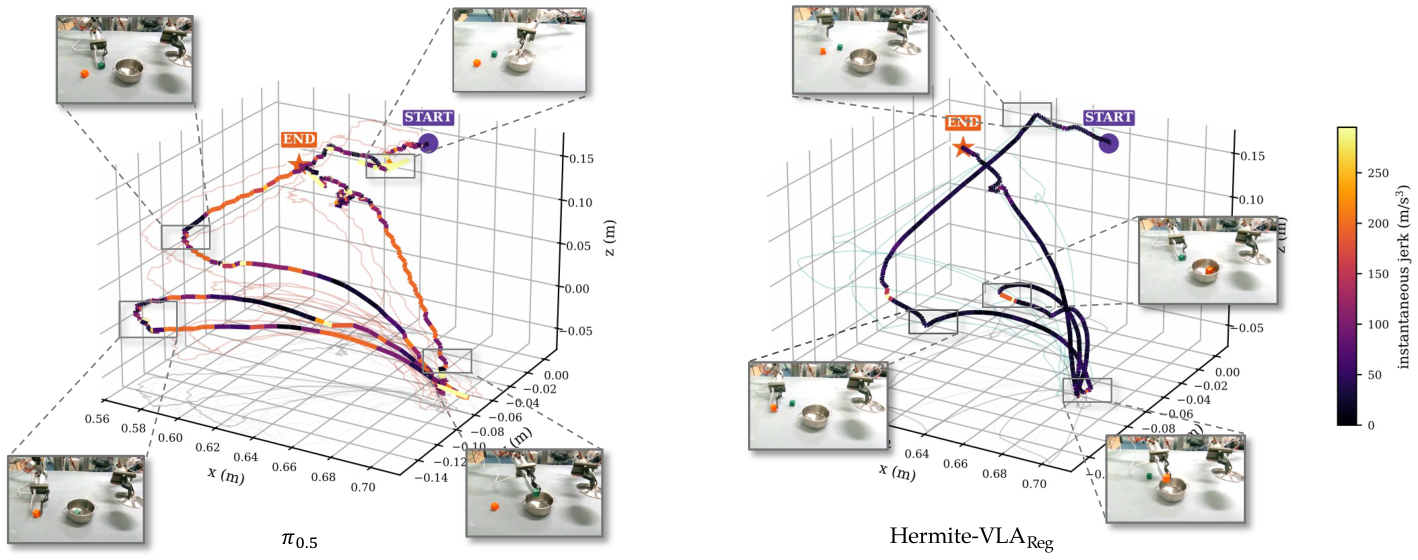
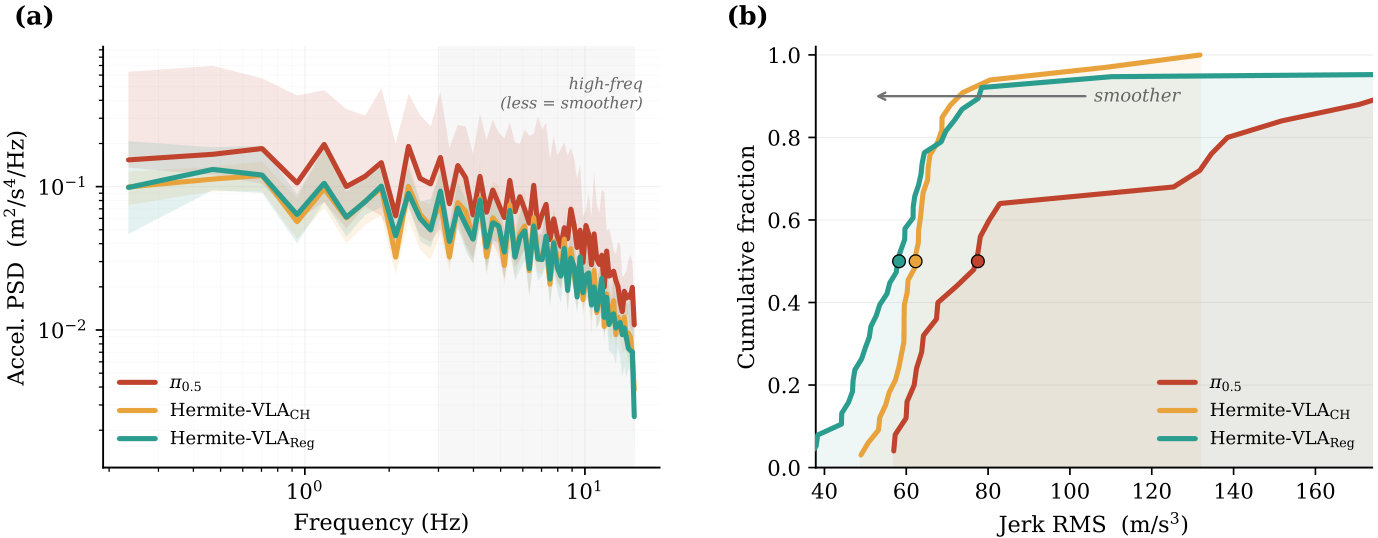
Task success alone does not expose how a policy moves. We therefore examine spatial paths and frequency-domain motion directly on physical hardware.
Please cite the manuscript when using the method or results.
@misc{lv2026hermitecurvestrajectorypriors,
      title={Hermite Curves as Trajectory Priors for Vision-Language-Action Models},
      author={Qi Lv and Jianming Xing and Zhao Yang and Mingyuan Yao and Yinan Shi and Yawei Jueluo and Mike Zheng Shou and Xiang Deng},
      year={2026},
      eprint={2608.01265},
      archivePrefix={arXiv},
      primaryClass={cs.RO},
      url={https://arxiv.org/abs/2608.01265},
}